
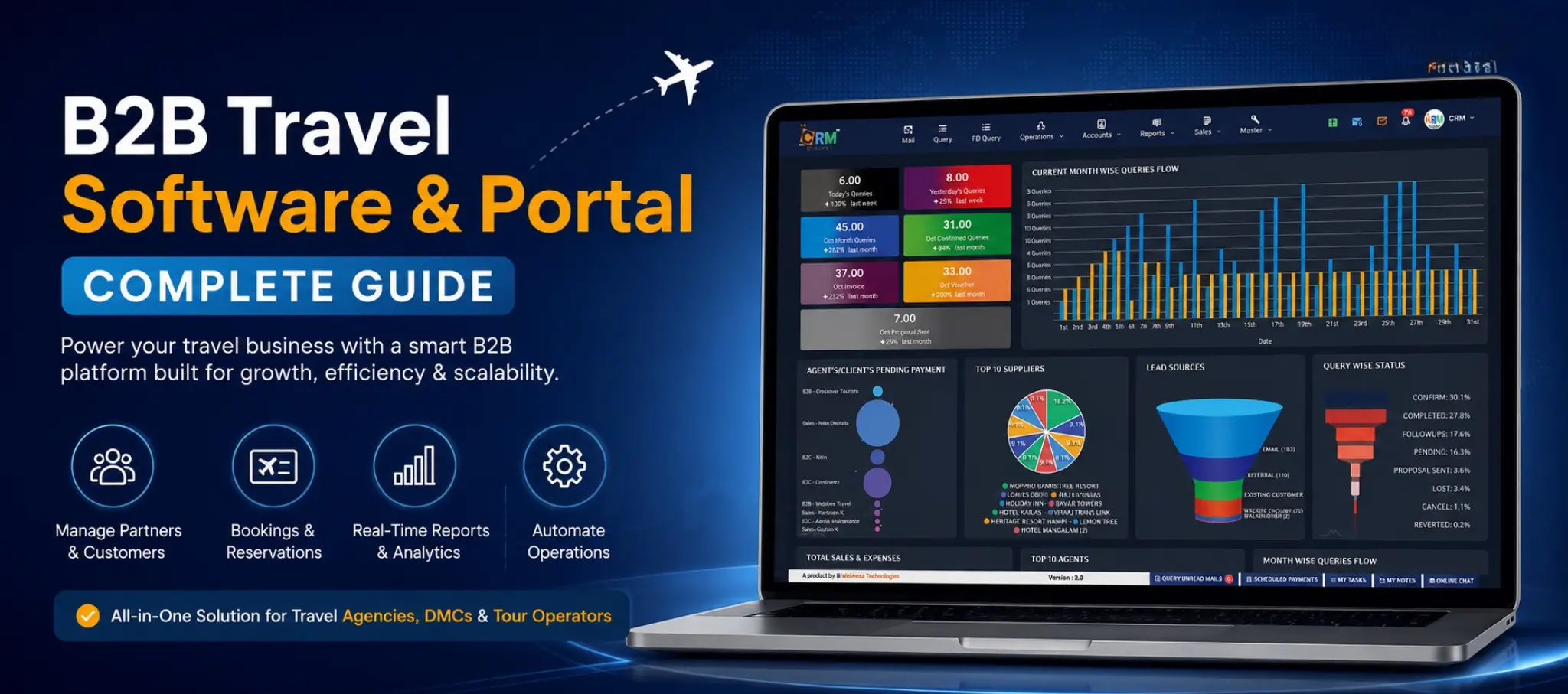
The travel distribution business has changed dramatically over the last decade. Manual bookings, endless email chains, and scattered spreadsheets no longer work for agencies that want to scale. Today, a reliable B2B travel software platform is what separates agencies that grow steadily from those that struggle to keep up with demand.
Whether you run a small travel agency, manage a Destination Management Company (DMC), or operate as a tour operator supplying inventory to sub-agents, a strong travel B2B portal is now the backbone of daily operations. This guide breaks down everything you need to know — features, pricing, registration, and how to pick the right CRM — so you can make an informed decision for your business.
What Is B2B Travel Software?
B2B travel software is a digital platform that connects travel suppliers (hotels, airlines, DMCs, tour operators) with buyers (travel agents, sub-agents, and corporate travel desks) through a single online marketplace. Instead of negotiating deals over phone calls or emails, agents log into a travel B2B portal, check live inventory, compare rates, and confirm bookings instantly.
A typical B2B travel portal includes modules for:
- ◼ Flight, hotel, and holiday package booking
- ◼ Real-time inventory and dynamic pricing
- ◼ Multi-currency and multi-language support
- ◼ Automated markup and commission management
- ◼ Payment gateway integration and wallet systems
- ◼ Reporting, MIS, and accounting dashboards
- ◼ Sub-agent and white-label management
By centralizing these functions, agencies save hours of manual work every week while reducing pricing errors and booking conflicts.
Why Travel Agencies, DMCs & Tour Operators Need a B2B Portal
Every stakeholder in the travel supply chain benefits differently from a B2B travel portal:
⚡ Travel Agencies get instant access to a wide inventory of flights, hotels, transfers, and packages without maintaining direct supplier relationships with every vendor.
⚡ DMCs (Destination Management Companies) can distribute their local packages, activities, and services to hundreds of agents worldwide without manual coordination.
⚡ Tour Operators can manage their own inventory, control markups centrally, and onboard unlimited sub-agents through a white-labelled interface — extending their market reach without extra staffing.
In short, a B2B portal converts a fragmented, relationship-driven business into a scalable, technology-driven one.
Key Features to Look for in the Best B2B Portal for Travel Agency
Not all platforms are built equally. When evaluating the best B2B portal for travel agency use, prioritise the following:
1. Unified Booking Engine – Flights, hotels, holiday packages, car rentals, and visa services in one dashboard.
2. Real-Time API Integration – Connectivity with GDS (Amadeus, Sabre, Galileo) and multiple hotel/flight aggregators for live rates and availability.
3. White Label Capability – Lets agencies launch their own branded booking website powered by the same backend.
4. Markup & Commission Engine – Set agent-wise, region-wise, or product-wise markups automatically.
5. Secure Payment Gateway – Multiple options including wallets, credit lines, and instant online payments.
6. Mobile Responsiveness – A portal usable on both desktop and mobile devices for agents on the go.
7. Dedicated CRM Module – To track leads, follow-ups, and customer communication history.
8. 24/7 Support & Uptime Guarantee – Since travel bookings happen round the clock, technical support cannot be limited to business hours.
A platform that combines all these features reduces dependency on multiple vendors and creates a single source of truth for your entire booking operation.
Best B2B Travel Portal in India: What Makes It Different
India's travel market is unique — price sensitivity, regional diversity, and a large network of small and mid-sized agents make the ecosystem highly competitive. The best B2B travel portal in India typically offers:
◼ Domestic + International inventory covering budget and premium segments
◼ Local payment methods such as UPI, net banking, and NEFT/RTGS support
◼ GST-compliant invoicing built directly into the booking flow
◼ Regional language support for agents operating in tier 2 and tier 3 cities
◼ Competitive commission structures tailored to India's high-volume, low-margin agent network
Given the scale of India's outbound and domestic travel demand, choosing a portal with strong local supplier tie-ups (railways, state tourism boards, regional DMCs) gives agencies a real edge over generic international platforms.
B2B Travel Software Price: What Should You Expect to Pay?
B2B travel software price varies widely depending on features, customization, and deployment type. Broadly, pricing falls into three models:
| Pricing Model | Typical Range | Best For |
| Subscription-based (SaaS) | Monthly/annual fee per user or agency | Small to mid-size agencies wanting quick setup |
| Commission-based | Percentage cut per booking, low/no upfront cost | Startups or agencies testing the market |
| One-time license + customization | Higher upfront investment, full ownership | Large tour operators or DMCs needing a fully branded solution |
Additional cost factors include:
- ◼ Number of API integrations (GDS, hotel aggregators, payment gateways)
- ◼ White-label branding and custom domain setup
- ◼ Number of sub-agent or user accounts
- ◼ Ongoing maintenance, hosting, and support charges
Before committing, always ask for a transparent cost breakdown, including hidden charges like API renewal fees or per-transaction costs. Comparing at least three vendors on a like-for-like feature basis will help you avoid overpaying for capabilities you may not need.
B2B Travel Agent Registration: How It Works
Getting started on a B2B travel platform is usually straightforward. The typical B2B travel agent registration process includes:
1. Sign-Up – Fill in business details such as company name, IATA/TAAI number (if applicable), GST details, and contact information.
2. Document Verification – Submit business registration proof, PAN/GST certificates, and bank details.
Account Approval – The platform provider verifies documents, typically within 24–48 hours.
3. Credit Line or Deposit Setup – Some portals require a minimum wallet top-up or security deposit before booking access is activated.
4. Training & Onboarding – Most providers offer a walkthrough of the dashboard, booking flow, and reporting tools.
5. Go Live – Once approved, agents can start searching, booking, and managing customer itineraries immediately.
A smooth, quick registration process is often a strong indicator of a vendor's overall service quality — if onboarding is confusing or slow, day-to-day support is likely to be the same.
Best Travel CRM: Why It's the Backbone of Agent Success
Booking technology alone isn't enough — converting leads into paying customers requires structured follow-up. This is where the best travel CRM tools come in. A travel-specific CRM helps agencies:
- ◼ Capture leads from website forms, social media, and walk-ins in one place
- ◼ Automate follow-up reminders and email/WhatsApp sequences
- ◼ Track the entire customer journey from inquiry to post-trip feedback
- ◼ Segment customers by destination interest, budget, or travel season
- ◼ Generate quotes and itineraries directly from within the CRM
Unlike generic sales CRMs, a travel-focused CRM understands seasonality, package customization, and multi-traveler bookings — making it far more effective for this industry.
CRM for Travel Agency: Features That Actually Matter
When selecting a CRM for travel agency operations, focus on functionality that directly impacts conversions and repeat business:
✔ Lead Scoring – Prioritize high-intent inquiries automatically
✔ Itinerary Builder Integration – Create and send quotes without switching tools
✔ Automated Reminders – Reduce missed follow-ups that lead to lost sales
✔ Multi-Channel Communication – Email, SMS, and WhatsApp integration in one inbox
✔ Analytics Dashboard – Track conversion rates, agent performance, and revenue by source
✔ Integration with Booking Engine – So confirmed bookings automatically update customer records
Agencies that pair a strong B2B travel portal with a dedicated CRM typically see measurably higher repeat-customer rates, since every interaction is tracked and no lead falls through the cracks.
How to Choose the Right B2B Travel Software for Your Business
Before finalizing a platform, ask these questions:
- ◼ Does it integrate with the suppliers and GDS systems you already work with?
- ◼ Is the pricing model aligned with your booking volume?
- ◼ Does it offer white-label branding if you plan to scale under your own name?
- ◼ How responsive is their support team, especially during peak booking hours?
- ◼ Can the CRM and booking engine work together seamlessly, or are they separate tools?
Taking time to test a demo account before signing a contract is one of the most effective ways to avoid costly platform-switching down the line.
Final Thoughts
Choosing the right B2B travel software is no longer optional for agencies, DMCs, and tour operators who want to remain competitive. From real-time booking capabilities to integrated CRM tools, the right travel B2B portal streamlines operations, reduces manual errors, and creates room for growth. Whether you're comparing the best B2B travel portal in India or evaluating global providers, focus on transparent pricing, smooth agent registration, and strong CRM functionality — these three factors, more than any flashy feature list, determine long-term success.
