
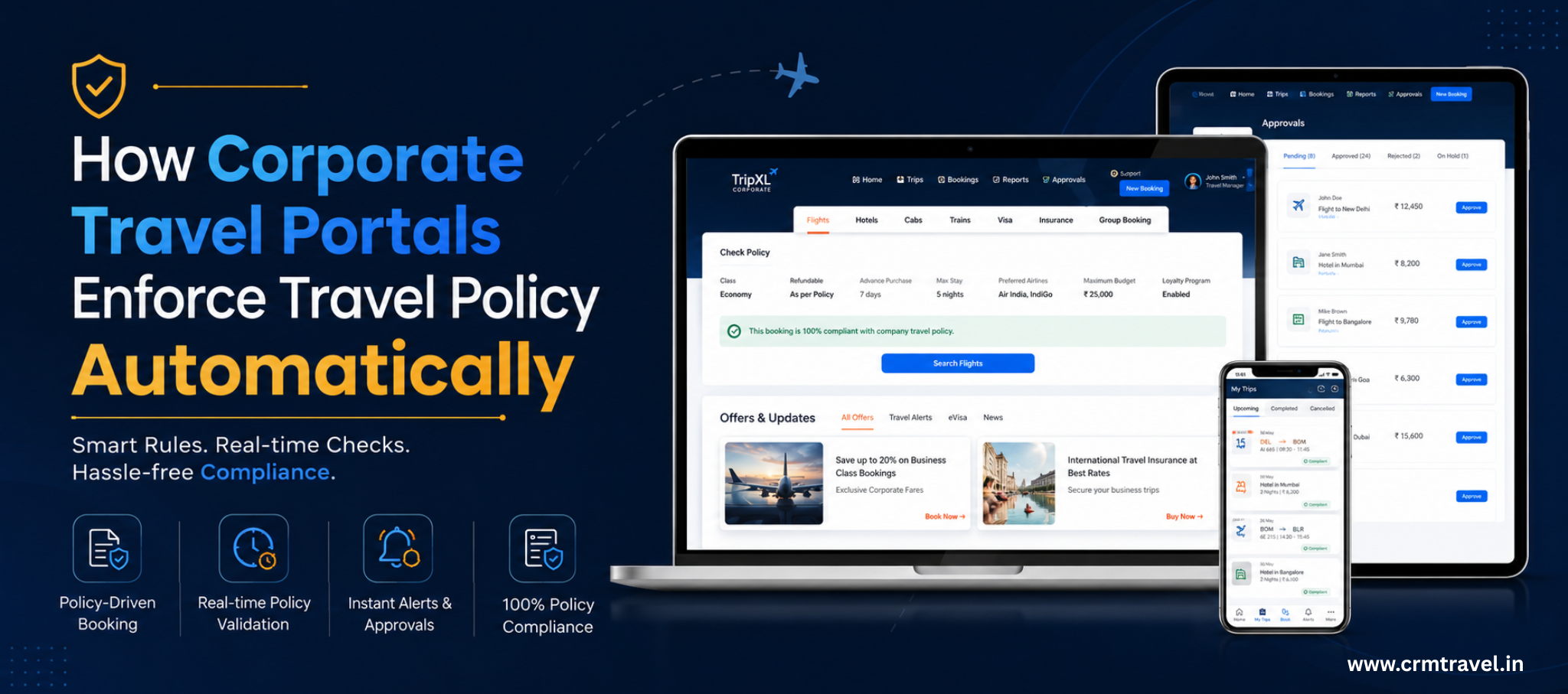
Introduction: The Policy Gap That Costs Companies Millions
An employee books a last-minute business-class flight for a domestic trip because it was "just easier." A sales manager reserves a five-star hotel because "the budget hotel was too far from the venue." A consultant submits a cab receipt that exceeds the daily transport limit — again.
None of these people are being malicious. They simply made choices in the moment, without real-time visibility into what the company policy actually allows. The result? Thousands in unnecessary spend, hours of back-and-forth approvals, and frustrated finance teams playing catch-up long after the money is already gone.
This is exactly the problem that modern corporate travel portals are built to solve — and they do it automatically.
What Is a Corporate Travel Portal?
A corporate travel portal is a centralised, company-configured platform that allows employees to search, book, and manage their business travel — flights, hotels, car rentals, and more — all in one place. But unlike a regular consumer booking site, a corporate travel portal is hard-wired with your organisation's specific travel policies.
Think of it less like a booking engine and more like a smart compliance layer built on top of a booking engine. Every search result, every price point, every booking option is filtered and ranked according to rules your company has already agreed upon.
How Corporate Travel Portals Enforce Policy — Automatically
1. Pre-Trip Policy Guardrails at the Point of Booking
The most powerful aspect of a corporate travel portal is that it enforces policy before a booking is made — not after. When an employee logs in and starts searching for flights, the system already knows:
- ◾ The maximum allowed fare class (economy vs. business)
- ◾ Advance booking windows (e.g., flights must be booked at least 7 days in advance)
- ◾ Preferred airline and hotel partners
- ◾ Per-night hotel spending caps for specific cities
Non-compliant options are either hidden entirely, greyed out with a warning, or flagged with an explanation. The traveller sees compliant options first. This approach works because it removes the need for employees to remember policy details — the portal simply presents the right choices.
2. Automated Approval Workflows
When a booking does fall outside policy — say, a traveller needs to stay in a higher-cost hotel due to a sold-out conference period — a corporate travel portal doesn't block the booking outright. Instead, it triggers an automated approval workflow.
The system sends a request to the relevant manager or finance approver, includes the reason for the out-of-policy booking, and tracks the approval status in real time. No emails to dig through. No spreadsheets to update. The entire process is logged and auditable from day one.
This is a meaningful shift: approvals go from taking days to taking minutes, and nothing slips through unnoticed.
3. Preferred Vendor Enforcement
Corporate travel portals are typically integrated with negotiated vendor contracts. If your company has a preferred hotel chain offering a corporate rate, the portal surfaces those properties first — and may even restrict bookings to those options unless an override is approved.
This matters enormously for cost management. When employees book through preferred vendors, companies capture the discounts they've negotiated, maintain accurate spend data, and build stronger vendor relationships over time. Without a portal, these agreements are only as good as an employee's willingness to remember them.
4. Real-Time Budget Visibility
One of the quieter but genuinely impactful features of a corporate travel portal is budget transparency. Both travellers and managers can see how much has been spent versus what remains in the travel budget — in real time.
When an employee knows they're approaching the departmental travel cap, behaviour changes naturally. When a manager receives a weekly summary of travel spend, they can course-correct early instead of discovering budget overruns at the end of the quarter.
This kind of visibility used to require a dedicated analyst pulling data from multiple systems. Now it's available at a glance, built into the booking flow.
5. Expense Integration and Receipt Matching
The best corporate travel portals don't stop at booking — they connect directly to expense management systems. When a trip is booked, the relevant expense categories are pre-populated. When receipts are submitted, the system cross-references them against the approved itinerary and flags discrepancies automatically.
Did someone submit a hotel bill that's ₹3,000 over the approved rate? The system flags it. Did a traveller claim an extra night that wasn't on the approved booking? That gets flagged too. Finance teams no longer need to manually audit every receipt — the portal does the heavy lifting.
6. Risk and Compliance Alerts
Modern corporate travel portals also include duty-of-care features that go beyond cost control. If a traveller books to a destination that has a recently issued travel advisory, the system alerts both the traveller and their manager. If a natural disaster or civil unrest event occurs in a city where employees are currently staying, the portal can identify affected travellers and initiate communication protocols instantly.
From a compliance standpoint, this is critical. Companies have a legal and ethical responsibility to know where their people are. A travel portal makes this possible without requiring a dedicated travel desk to track every itinerary manually.
The Business Case: Why Automation Beats Manual Enforcement
Let's be direct about something: manually enforcing travel policy doesn't work at scale.
When policy compliance depends on employees reading a PDF, managers reviewing bookings on request, and finance teams auditing expenses after the fact, exceptions become the norm. Not because people don't care — but because the friction of checking policy in the moment is higher than the friction of just booking what seems reasonable.
Corporate travel portals flip this dynamic. They make the compliant path the easiest path. They make non-compliant choices visible, not invisible. And they shift policy enforcement from a human activity (reactive, inconsistent, slow) to a system activity (proactive, consistent, instant).
Companies that deploy corporate travel portals typically report meaningful reductions in travel spend and significant improvements in policy compliance rates — outcomes that would require substantial headcount to achieve through manual processes.
What to Look for in a Corporate Travel Portal
When evaluating a platform, look for these core capabilities:
- ◾ Configurable policy rules — Can you set different policies by department, seniority level, or destination?
- ◾ Seamless integrations — Does it connect with your HR system, expense platform, and ERP?
- ◾ Approval workflow flexibility — Can you define multi-level approvals for different exception types?
- ◾ Reporting and analytics — Are spend patterns, policy violations, and vendor performance easy to track?
- ◾ Mobile accessibility — Can travellers manage bookings on the go?
-
◾ Duty-of-care tools — Does the platform track traveller locations and issue real-time alerts?
