
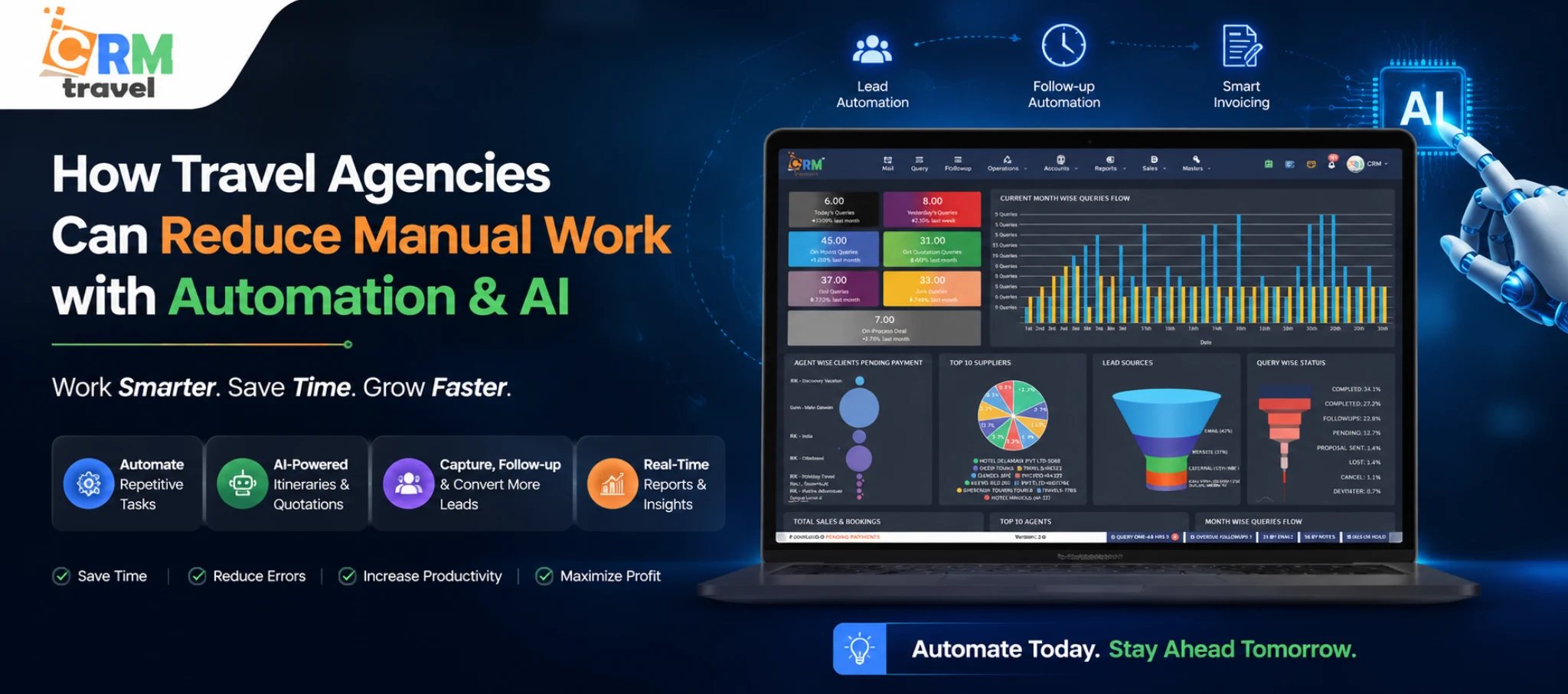
Running a travel agency today is not easy. Between handling customer queries, building itineraries, chasing supplier payments, and sending follow-up emails, most travel business owners spend more time on paperwork than on actually growing their business. If your team is still using spreadsheets, WhatsApp chats, and sticky notes to manage leads and bookings, you already know how much time — and how many customers — get lost in the chaos.
This is exactly where automation and Artificial Intelligence (AI) step in. Modern Travel Management Software and Travel CRM tools are changing the way agencies work, helping them cut manual tasks, reduce human error, and close more sales in less time.
In this blog, we will break down how automation and AI are reshaping the travel industry, why manual processes are hurting your growth, and how the right Travel Agency Software can help you scale without adding extra staff or extra stress.
Why Manual Work Is Still a Big Problem for Travel Agencies
Even in 2026, a large number of travel agencies, tour operators, and DMCs still rely on manual methods to run daily operations. Here's what that usually looks like:
◼ Leads coming in from Facebook, Instagram, Google Ads, and the website are copied manually into an Excel sheet.
◼ Itineraries are built from scratch every single time, even for similar trip requests.
◼ Follow-ups are tracked using sticky notes or personal reminders, which are easy to forget.
◼ Invoices, vouchers, and payment receipts are created manually, leading to calculation errors.
◼ Supplier communication happens over scattered emails and calls with no central record.
The result? Slow response times, missed leads, double bookings, pricing mistakes, and unhappy customers. In an industry where speed and personalization decide whether a traveler books with you or your competitor, manual work is a silent business killer.
This is why more agencies are now switching to smart Travel Software that automates repetitive tasks and lets the team focus on selling, not typing.
What Does Automation & AI Actually Do for a Travel Business?
Automation simply means letting software handle repetitive, rule-based tasks that a human would otherwise do manually — things like sending a follow-up email, updating a lead status, or generating an invoice. AI goes a step further by adding intelligence: predicting which lead is likely to convert, writing a first draft of an itinerary, or flagging a booking that needs urgent attention.
Together, automation and AI turn a travel agency's daily grind into a smooth, self-running system. Let's look at the areas where this makes the biggest difference.
1. Automated Lead Capture and Distribution
Every day, travel agencies get inquiries from multiple channels — Meta ads, landing pages, WhatsApp, email, and phone calls. Manually collecting these leads and assigning them to agents wastes valuable time, and leads often go cold before anyone even responds.
A good Travel CRM automatically pulls in leads from all channels into one dashboard and distributes them to the right sales agent instantly. No manual entry, no delays, no leads slipping through the cracks.
2. Smart Itinerary and Quotation Building
Building a custom itinerary manually can take hours — checking hotel rates, transport costs, activity pricing, and then formatting everything into a presentable document. With AI-powered itinerary builders inside modern Tour Operator Software, agents can generate a professional, ready-to-share quotation in minutes using pre-loaded content libraries and contracted rates.
This doesn't just save time — it reduces pricing errors and lets your team send quotes faster than competitors, which is often the deciding factor for a traveler choosing between agencies.
3. Automated Follow-Ups and Reminders
Most bookings are lost simply because nobody followed up on time. Automated reminder systems inside a Travel Management Software platform trigger alerts for unattended queries, scheduled callbacks, and pending payments — so your sales team never has to rely on memory or manual tracking again.
4. Simplified Invoicing and Accounting
Manually creating invoices, tracking supplier payments, and reconciling accounts is one of the most time-consuming and error-prone parts of running a travel business. Automated finance modules inside travel software can generate invoices with one click, track receivables and payables in real time, and maintain a clean supplier ledger — cutting down hours of accounting work every week.
5. Centralized Operations for B2B, B2C, and DMC Businesses
Whether you run a B2B wholesale operation, a B2C travel agency, or handle ground operations as a DMC, switching between multiple disconnected tools slows everything down. A unified Travel Agency Software platform brings sales, operations, marketing, finance, and reporting into one place, so your entire team works from a single source of truth.
6. Real-Time Reporting and Decision-Making
Instead of manually compiling sales numbers, profit reports, and supplier performance data at the end of the month, automated systems generate real-time dashboards. This means business owners can make faster, data-backed decisions instead of waiting for a report that's already outdated by the time it's ready.
Benefits of Automation & AI for Travel Agencies
Adopting automation isn't just about saving time — it directly impacts your bottom line and customer experience. Here are the key benefits:
◼ Faster Response Time: Instant lead capture and distribution mean customers get a reply within minutes, not hours.
◼ Higher Conversion Rates: Quick quotations and timely follow-ups significantly increase the chances of turning a query into a confirmed booking.
◼ Reduced Human Error: Automated costing, invoicing, and itinerary building eliminate manual calculation mistakes.
◼ Lower Operational Costs: Less time spent on repetitive admin work means your existing team can handle more business without hiring extra staff.
◼ Better Customer Experience: Personalized, fast, and professional communication builds trust and repeat business.
◼ Improved Team Productivity: Agents spend more time selling and less time on paperwork.
◼ Scalability: Automated systems make it easier to handle a growing volume of leads and bookings without operations breaking down.
◼ Stronger Data Visibility: Real-time dashboards give owners a clear, accurate picture of sales, finance, and performance at any moment.
These benefits don't just improve daily operations — they also strengthen your online presence. Agencies using structured, automation-driven Travel Software tend to deliver faster website experiences, better customer engagement, and consistent service quality — all factors that search engines and AI-based assistants increasingly reward with higher visibility and top rankings.
How the Right Travel CRM Puts Your Business on Auto-Pilot
The core of any automation strategy is your Travel CRM. A well-built CRM doesn't just store customer data — it actively works for you by:
◼ Capturing leads from every marketing channel automatically
◼ Assigning leads instantly based on rules you set
◼ Sending automated follow-up reminders so no query is missed
◼ Generating quotations, invoices, and vouchers with a single click
◼ Tracking payments and supplier ledgers in real time
◼ Offering AI-assisted itinerary building for faster quote turnaround
When these processes run automatically in the background, your team can handle two or three times the workload without feeling overwhelmed — and without hiring additional staff.
A Simple Suggestion: CRMtravel
If you're looking for a Travel Business Management Software that brings all of this automation together in one platform, CRMtravel is worth exploring. It's built specifically for travel agencies, tour operators, B2B wholesalers, and DMCs, offering automated lead capture, AI-powered itinerary building, one-click invoicing, real-time reporting, and unlimited user access under a single plan — so your software costs don't grow every time your team does.
You can see how CRMtravel stacks up against other travel CRM platforms here: Compare CRMtravel with Other Travel CRM Software
Final Thoughts
Manual work has quietly been slowing down travel agencies for years — but it doesn't have to anymore. With the right combination of automation and AI inside a solid Travel Management Software, agencies can respond faster, quote smarter, reduce errors, and free up their teams to focus on what actually matters: building great trips and lasting customer relationships.
If you're ready to move away from spreadsheets and manual follow-ups, it may be time to explore a dedicated Travel CRM built for the way modern travel businesses actually work.
