
Tour or Travel Itinerary Builder Software for Travel Agents

CRMtravel™ is the Best Itinerary Builder Software for travel agents in 2025. Create an Itinerary in just a few Clicks with CRMtravel™ Software.

Book your free demo in just one click
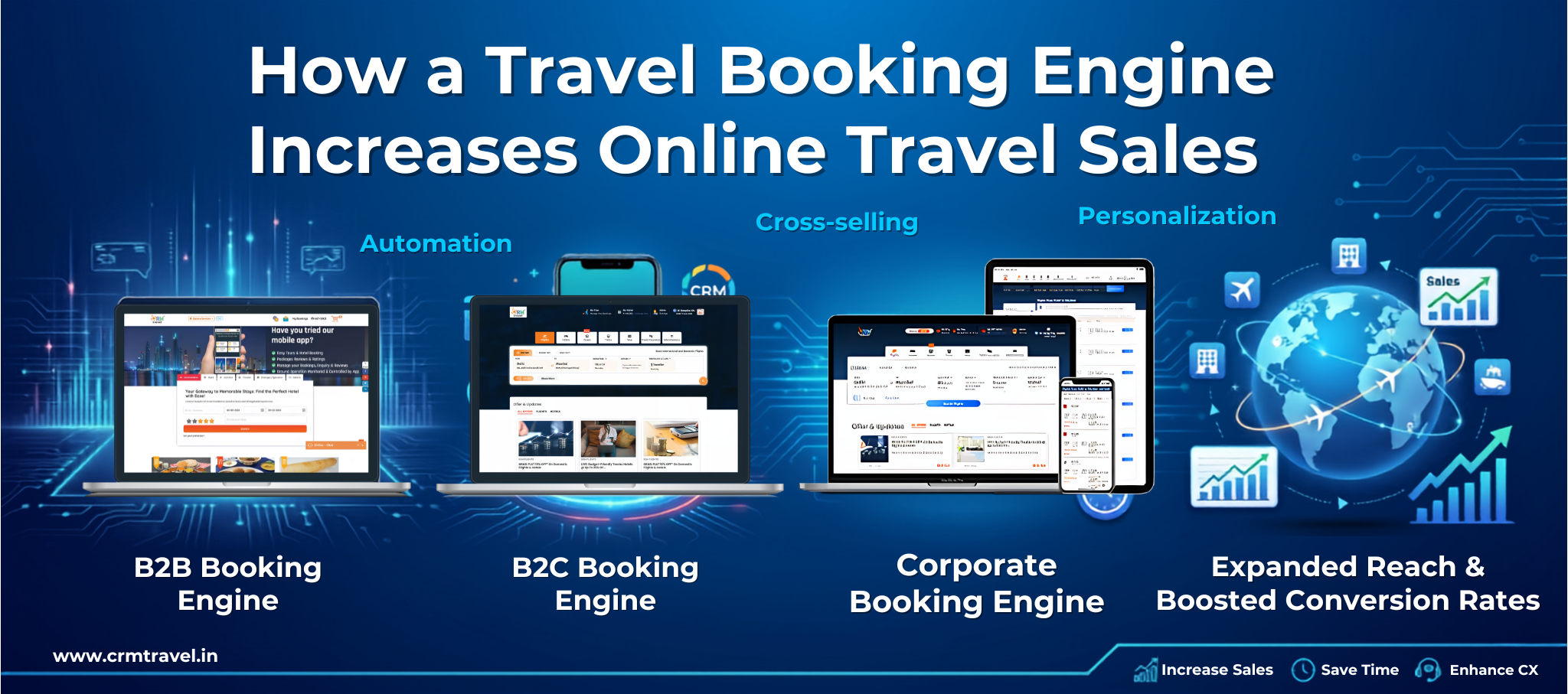
How a Travel Booking Engine Increases Online Travel Sales

How a Travel Booking Engine Increases Online Travel Sales

A travel booking engine helps travel businesses increase sales by offering real-time bookings, instant confirmations, automated workflows, and 24/7 availability. Whether B2B, B2C, or Corporate, it streamlines operations, improves customer experience, expands distribution channels, and boosts conversions while reducing manual work and operational costs.

Published: June 05, 2026

    How a Travel Booking Engine Increases Online Travel Sales

    05-06-2026
    How a Travel Booking Engine Increases Online Travel Sales

    The travel industry is no longer driven by phone calls and paper brochures. In an era where travelers expect instant confirmations, mobile-first experiences, and personalized itineraries, a robust travel booking engine has become the backbone of every successful online travel business. Whether you are running a travel agency, a corporate travel management firm, or a consumer-facing OTA, the right booking engine can transform your sales funnel and dramatically increase revenue.


    Higher conversion with real-time booking

    68%

    Travelers prefer self-service booking portals

    40%

    Cost reduction via automated workflows


    What Is a Travel Booking Engine?

    A travel booking engine is a software platform that allows customers or partners to search, compare, and purchase travel products — including flights, hotels, car rentals, transfers, and holiday packages — all in real time. It connects to global distribution systems (GDS), airline APIs, and hotel aggregators to fetch live inventory and pricing, enabling seamless transactions without manual intervention.

    Modern booking engines go well beyond simple search tools. They incorporate dynamic packaging, CRM integrations, payment gateways, and analytics dashboards — giving travel businesses a 360° view of their operations while delivering a frictionless experience to buyers. Understanding the three core types of booking engines is key to knowing how each one drives sales growth.


    The Three Primary Types of Travel Booking Engines


    B2B Travel Booking Engine (Businness To Business)

    Designed for travel agencies, tour operators, and wholesalers, a B2B travel booking engine empowers sub-agents and distribution partners to book travel inventory on behalf of their own clients. It features tiered pricing, markup controls, credit management, and white-label capabilities — giving travel companies the tools to grow their reseller networks and scale revenue without proportionally increasing headcount.


    B2C Travel Booking Engine (Business To Customer)

    A B2C travel booking engine puts booking power directly in the hands of the end traveler. Built with intuitive search interfaces, real-time availability, multi-currency support, and secure payment processing, it drives direct bookings, reduces dependency on third-party OTAs, and improves margin per booking. Personalization features such as saved preferences and loyalty rewards further increase repeat purchases and customer lifetime value.


    Corporate Travel Booking Engine (Enterprise Travel)

    A corporate travel booking engine is purpose-built for organizations that manage frequent business travel. It enforces travel policy compliance, automates approval workflows, tracks travel spend by department, and integrates with expense management platforms. By giving employees a self-booking portal within predefined guardrails, companies significantly cut administrative costs while gaining granular visibility into their travel budgets.


    How a Travel Booking Engine Drives Online Sales

    The connection between a well-implemented booking engine and higher sales is direct and measurable. Here is how each dimension of the technology contributes to revenue growth.

    "A travel booking engine does not just automate transactions — it removes every obstacle standing between a motivated buyer and a completed purchase, at any hour, from any device."

    24/7 availability and instant confirmation eliminate the friction of business-hours-only service. When a customer can book a flight at midnight and receive a confirmed itinerary within seconds, abandonment rates plummet. This round-the-clock accessibility is especially powerful for B2C platforms targeting global audiences across multiple time zones.


    For B2B travel booking engines, the sales impact comes from empowering a network of agents. When sub-agents have access to live inventory, competitive net fares, and instant booking confirmation, they sell faster and in higher volumes. Automated invoicing and credit limit management mean less back-and-forth, which translates directly into more completed bookings per agent per day.


    Corporate travel booking engines increase sales — in terms of captured spend — by channeling travel purchases through a managed platform rather than letting employees book ad-hoc on consumer sites. This policy compliance ensures negotiated rates are actually used, preferred suppliers are prioritized, and duty-of-care obligations are met.

    Key Revenue-Boosting Features to Look For


    • ✔ Real-time GDS & API connectivity for live pricing
    • ✔ Multi-language and multi-currency support
    • ✔ Automated approval workflows for corporates
    • ✔ CRM integration and customer profile management
    • ✔ Dynamic packaging of flights, hotels & transfers
    • ✔ White-label branding for B2B partner portals
    • ✔ Upsell and cross-sell modules (insurance, seats)
    • ✔ Analytics dashboards for data-driven decisions


    Choosing the Right Engine for Your Business

    Selecting a travel booking engine requires aligning the platform's capabilities with your specific sales model. A B2B travel booking engine should prioritize supplier management, markup flexibility, and agent-facing UI simplicity. A B2C travel booking engine must excel at conversion optimization — fast load times, mobile responsiveness, and a transparent checkout process matter enormously when competing with established OTAs. A corporate travel booking engine needs deep ERP and HR system integrations to function smoothly within an enterprise technology ecosystem.


    Whichever type you deploy, scalability is non-negotiable. As your booking volumes grow and supplier relationships expand, the engine must handle concurrent transactions without degrading performance. Cloud-based architectures with API-first designs offer the flexibility and uptime guarantees that modern travel businesses demand.


    Ultimately, a travel booking engine is not a cost center — it is a revenue engine in the truest sense. By automating the booking process, expanding distribution reach, and delivering a superior customer experience, it compounds sales growth over time. Whether your focus is on B2B networks, direct B2C conversions, or managed corporate travel programs, the right booking engine is the single most impactful technology investment a travel business can make in the digital era.

    Frequently Questions

    Everything you need to know — answered clearly

    What is a travel booking engine? +
    A travel booking engine is a software solution that enables customers, travel agents, or corporate users to search, compare, and book travel services such as flights, hotels, transfers, and holiday packages in real time.
    How does a travel booking engine increase online sales? +
    A travel booking engine increases sales by providing 24/7 booking access, instant confirmations, real-time pricing, and a seamless user experience that reduces booking abandonment and improves conversion rates.
    What is the difference between B2B and B2C travel booking engines? +
    A B2B travel booking engine is designed for travel agents and sub-agents with features like markups and credit management, while a B2C travel booking engine allows end customers to book travel services directly online.
    Can a travel booking engine integrate with airlines and hotels? +
    Yes, modern travel booking engines integrate with GDSs, airline APIs, hotel suppliers, and other travel content providers to deliver live inventory, pricing, and availability to users.
    Why should travel businesses invest in a travel booking engine? +
    A travel booking engine automates booking processes, reduces operational costs, expands distribution channels, improves customer satisfaction, and helps travel businesses generate more revenue through online sales.
    What are the benefits of a Corporate Travel Booking Engine? +
    A Corporate Travel Booking Engine helps organizations manage business travel efficiently by automating approval workflows, enforcing travel policies, tracking travel expenses, and providing employees with a self-service booking portal. This improves compliance, reduces costs, and gives companies better visibility into travel spending.

    Still if you want to ask something

    Get in Touch
    Send Whatsapp message