
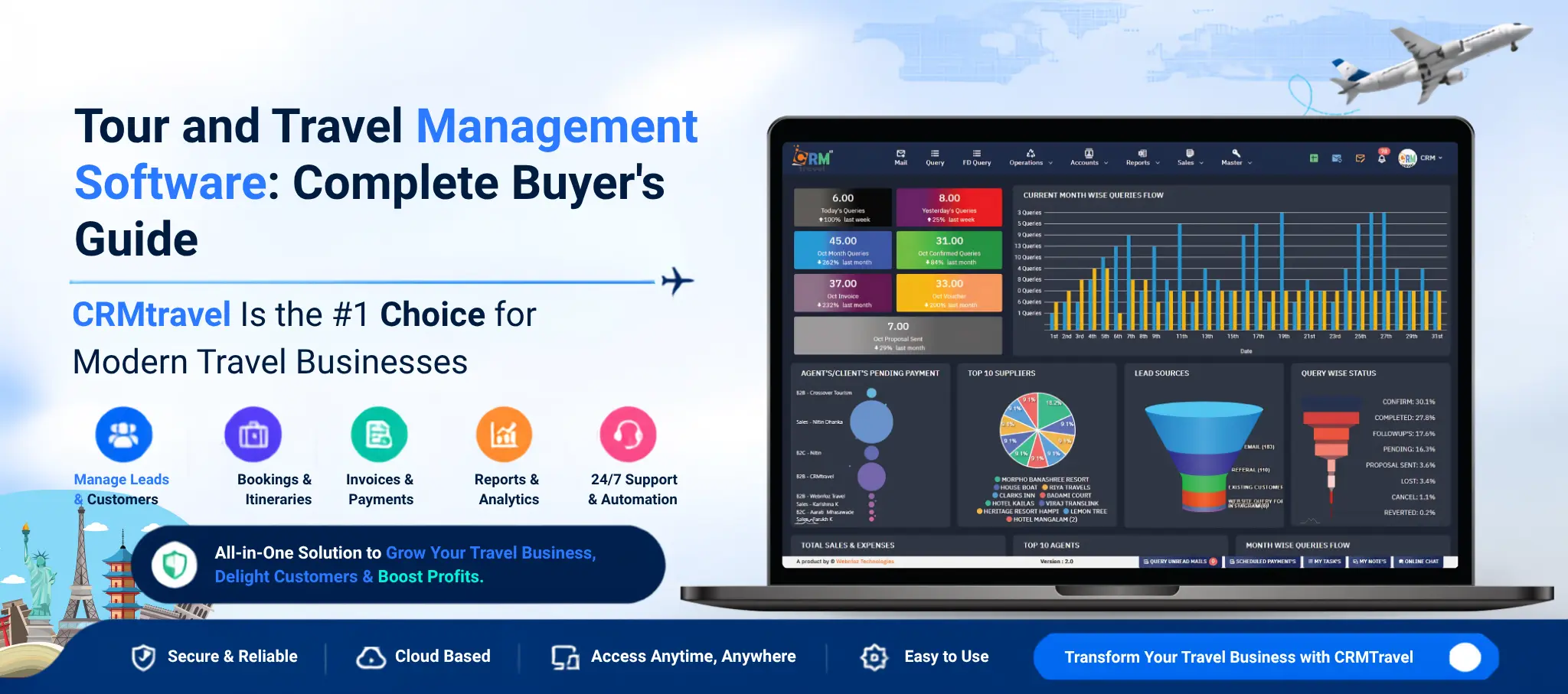
Running a travel business on spreadsheets and email threads stopped being sustainable years ago. Between managing quotes, supplier bookings, itineraries, payments, and customer communication, travel companies that still rely on manual processes are losing hours every day — and losing bookings to competitors who quote faster and follow up smarter.
That's where Tour and Travel Management Software comes in. Whether you run a boutique tour operation, a full-service travel agency, or a Destination Management Company (DMC), the right platform can turn scattered admin work into one connected, automated system. This guide breaks down what this software actually does, who needs it, what to look for, and how to choose between the dozens of platforms competing for your business in 2026.
What Is Tour and Travel Management Software?
Tour and Travel Management Software is a digital platform that helps travel businesses plan, sell, and manage trips from a single dashboard. Instead of juggling supplier emails, Excel itineraries, and separate payment tools, everything — enquiries, quotes, bookings, supplier contracts, invoicing, and reporting — lives in one system.
At its core, this category includes three closely related but distinct types of tools:
⚡ Tour Management Software — built for tour operators who package multi-day itineraries, group tours, or activity-based experiences.
⚡ Travel Management Software — a broader term covering corporate travel management, expense tracking, and trip approvals for businesses and travel agencies alike.
⚡ Travel Agent Software / Travel Agency Software — designed for retail and online travel agents who need CRM, booking engines, and commission tracking.
Most modern platforms blend these functions, offering a single suite that adapts to tour operators, retail agencies, corporate travel desks, and DMCs.
Who Actually Needs This Software?
If any of the following sound familiar, it's time to look at a dedicated platform:
◼ You're managing bookings across email, WhatsApp, spreadsheets, and a booking portal — with no single source of truth.
◼ Your team spends more time building itineraries manually than selling.
◼ You struggle to track supplier payments, commissions, or profit margins per trip.
◼ Customers are asking for real-time updates you can't easily provide.
◼ You're scaling into new markets or adding B2B/white-label partners and your current setup can't keep up.
This applies equally to independent travel agents, mid-size tour operators, inbound/outbound DMCs, and travel management companies (TMCs) serving corporate clients.
Core Features to Look For
Not every platform is built the same way, and buying based on price or brand recognition alone is a common mistake. Here's what actually matters.
1. Itinerary Builder & Quotation Engine
A strong tour management software should let you build customized, branded itineraries in minutes — not hours — with drag-and-drop day plans, real-time pricing, and PDF/web export options for clients.
2. Centralized Booking & Reservation Management
Look for a unified inbox that pulls in hotel, flight, transport, and activity bookings from multiple suppliers, so nothing gets missed or double-booked.
3. CRM and Lead Management
Good travel agent software tracks every lead from first enquiry to final payment, with automated follow-ups, tagging, and conversion reporting — so no enquiry goes cold.
4. Supplier and Contract Management
For DMCs especially, managing rate contracts, allotments, and supplier commissions is critical. The system should flag rate changes and expiring contracts automatically.
5. Payments, Invoicing & Accounting Integration
Automated invoicing, multi-currency support, and integration with accounting tools (QuickBooks, Xero, Tally) save hours of reconciliation work every month.
6. B2B and White-Label Capabilities
If you sell through sub-agents or resellers, your travel agency software should support white-label booking portals with custom markup rules.
7. Reporting and Analytics
Real-time dashboards showing revenue, occupancy, agent performance, and margin per tour help owners make faster, better decisions.
8. Mobile Access
Field staff, tour guides, and traveling clients need mobile-friendly access to itineraries, documents, and live updates — not just a desktop dashboard.
9. Integrations
API access to GDS systems, payment gateways, channel managers, and marketing tools (like Mailchimp or WhatsApp Business) determines how well the software fits into your existing tech stack.
10. Security and Compliance
Data protection, PCI-DSS compliance for payments, and role-based access controls matter more as your team and customer base grow.
Tour Management Software vs. Travel Agency Software: What's the Difference?
This is one of the most common points of confusion for buyers.
✔ Tour Management Software is typically optimized for operators selling packaged, multi-day, or group experiences — think itinerary building, group allotments, and guide/vehicle scheduling.
✔ Travel Agency Software tends to focus more on the sales and booking side: flight/hotel search, CRM, commission tracking, and customer communication — suited to retail and online travel agents (OTAs).
✔ Travel Management Software, meanwhile, often refers to platforms built for managing travel at scale — corporate travel policies, approval workflows, and expense management — used by TMCs and in-house travel desks.
Many vendors today build modular platforms so you only pay for the modules relevant to your business type, rather than forcing a one-size-fits-all system.
How to Evaluate Vendors: A Practical Checklist
Before signing a contract, run every shortlisted vendor through these questions:
1. Does it match your business model? A platform built for solo travel agents won't scale for a 50-person DMC, and vice versa.
2. What's the real total cost? Ask about setup fees, per-user pricing, transaction fees, and costs for add-on modules.
3. How long is the implementation? Some platforms go live in days; others take months of data migration and staff training.
4. Is support responsive and local? Time-zone-aware support matters if your operations span multiple countries.
5. Can you test it first? Insist on a free trial or live demo with your own sample itineraries and data.
6. What do existing customers say? Look for reviews from businesses of a similar size and niche — corporate travel needs differ vastly from adventure tour operators.
7. Is it built to scale? Check whether the vendor supports multi-branch, multi-currency, and multi-language operations if you plan to expand.
Common Buying Mistakes to Avoid
◼ Choosing on price alone. The cheapest plan often lacks the integrations or support you'll need within a year.
◼ Ignoring data migration. Moving years of customer and booking history badly can break reporting and customer trust.
◼ Skipping the trial period. A polished demo doesn't always reflect daily usability for your team.
◼ Overbuying features you won't use. Enterprise-grade suites can overwhelm small teams; start with what you need and scale up.
◼ Underestimating training time. Even the best software fails if your team isn't properly onboarded.
The 2026 Outlook: Where This Software Is Heading
Travel technology in 2026 is being shaped by a few clear trends worth factoring into your buying decision:
◼ AI-assisted itinerary generation is becoming standard, cutting quote-building time significantly.
◼ Real-time supplier integrations are replacing manual rate updates, reducing pricing errors.
◼ Unified CRM + booking + payments platforms are consolidating what used to be three or four separate tools.
◼ Sustainability and compliance reporting are increasingly built into enterprise-grade DMC platforms.
◼ API-first architecture is now a baseline expectation, not a premium feature, since travel businesses rely on multiple connected systems.
Choosing a platform with an active development roadmap — not just current features — will matter more over the next few years than it has in the past.
Final Thoughts
The right Tour and Travel Management Software isn't the one with the longest feature list — it's the one that fits how your business actually operates today, while giving you room to grow. Start by mapping your current workflow gaps, shortlist two or three vendors that specialize in your segment (tour operator, agency, or DMC), and test them with real bookings before committing.
Travel businesses that make this shift early aren't just saving admin time — they're winning more bookings by quoting faster, following up smarter, and giving customers a smoother experience from enquiry to return trip.
