Introduction
Winning a new customer is an important milestone for any travel agency. However, the real value of that customer often becomes clear after the first trip is completed.
Consider a traveler who books a family holiday through your agency. Your team handles the hotel reservations, transportation, sightseeing arrangements, and travel documents. The trip goes smoothly, and the customer returns home satisfied.
What happens next?
If your agency waits until the customer contacts you again, you may miss opportunities to build a lasting relationship. That traveler might book their next holiday with another agency simply because a competitor reached out at the right time with a relevant offer.
This is a challenge many travel businesses face. They concentrate heavily on generating new enquiries and closing current deals but give less attention to customers who have already purchased their services.
A better approach is to treat every completed booking as the beginning of a potential long-term relationship.
With a structured retention strategy, travel agencies can stay connected with previous customers, understand their preferences, recommend relevant travel experiences, and encourage future bookings. The right travel agency CRM software can make this process easier by organizing customer records, tracking communication, and helping teams manage follow-ups.
In this guide, we will explore practical ways to build a post-booking customer retention system that supports sustainable travel business growth.
1. Understand What Happens After the Customer Returns
The customer journey should not end when the traveler reaches home. In fact, the period immediately after a trip provides an opportunity to understand their experience and identify future requirements.
Many agencies focus on the stages leading up to a booking:
◾Receiving a travel enquiry.
◾Preparing a quotation.
◾Suggesting hotels and activities.
◾Confirming reservations and collecting payments.
◾Coordinating the trip.
However, post-trip communication deserves equal attention.
For example, a couple who recently booked an anniversary holiday might be interested in an international vacation next year. A family that enjoyed a summer trip may want a winter getaway. A corporate customer may require travel arrangements for upcoming business meetings.
These future opportunities are easier to identify when the agency maintains useful customer records.
After each completed trip, record relevant information such as the destination, type of holiday, approximate budget range, preferred travel style, and feedback. Collect only the information needed for your business, and handle personal data securely.
Over time, these records help your team understand customers beyond their original booking.
2. Create a Post-Trip Follow-Up Process
A simple follow-up message can help keep your agency connected with a customer after their holiday.
Instead of leaving post-trip communication to individual employees, establish a consistent process.
Step 1: Send a welcome-home message
Once the trip is completed, send a friendly message thanking the customer for choosing your agency.
Keep the communication personal and conversational rather than turning it into an immediate sales pitch.
Step 2: Ask for feedback
Invite the traveler to share their experience. Ask whether the hotel, transportation, itinerary, and overall arrangements met their expectations.
Feedback can reveal service improvements that may otherwise go unnoticed.
Step 3: Resolve outstanding concerns
If the customer experienced a problem, acknowledge it and work toward a suitable resolution. A timely response can help protect the relationship and demonstrate accountability.
Step 4: Update the customer profile
Add relevant feedback and travel preferences to the customer's record. This gives your team useful context when preparing future recommendations.
Step 5: Schedule an appropriate future follow-up
Depending on the customer's preferences and consent, schedule a reminder for a future holiday season or another relevant occasion.
A structured process helps ensure that customer relationships do not depend entirely on an employee remembering to make a call.
3. Use Travel History to Recommend Relevant Packages
Generic promotions are easy to ignore. Personalized recommendations are more useful when they reflect a traveler's interests, budget, and previous experiences.
Imagine that your agency has three customers:
Customer A: A family that frequently books summer holidays and prefers hotels with family-friendly facilities.
Customer B: A couple interested in cultural experiences, heritage destinations, and boutique accommodation.
Customer C: A corporate traveler who regularly requires flights, hotels, and airport transfers for work.
Sending the same holiday package to all three customers would probably be ineffective.
Instead, your agency could recommend family vacation packages to Customer A, a cultural tour to Customer B, and convenient corporate travel arrangements to Customer C.
This approach makes communication more relevant and helps your sales team focus on genuine opportunities.
A travel CRM can support this process by keeping customer information, previous bookings, enquiry history, and follow-up activities organized in one place. Your team can then use those records to prepare suitable offers rather than starting from scratch with every interaction.
The objective is not to contact customers more frequently. It is to contact them with something genuinely useful.
4. Build a Customer Communication Calendar
Travel demand often follows recognizable patterns, including school holidays, festive periods, summer vacations, winter breaks, and major business events.
A communication calendar helps your agency plan customer engagement around these opportunities.
For example, your calendar could include:
| Period |
Communication opportunity |
| Shortly after a trip |
Thank-you message and feedback request |
| Before the summer season |
Family holiday inspiration |
| Before winter vacations |
Mountain destinations and seasonal packages |
| Before major festive holidays |
Relevant domestic and international offers |
| Ahead of known corporate travel periods |
Business travel planning assistance |
| Around a customer's preferred booking period |
A personalized travel reminder |
These are planning examples rather than fixed rules. The best timing depends on the destination, booking window, customer preferences, and consent.
Avoid sending too many messages. Give customers an easy way to manage their communication preferences and opt out of promotional messages.
A planned communication calendar keeps outreach organized while helping your agency avoid repetitive or irrelevant promotions.
5. Make Every Customer Interaction Feel Connected
Customers can become frustrated when they need to explain their requirements repeatedly.
For example, a returning customer may contact your agency and expect the team to remember their previous destination, hotel preferences, or preferred way of communicating. If the employee handling the enquiry has no access to earlier conversations, the customer must repeat the same information.
This problem becomes more common as agencies grow and enquiries move between sales representatives, operations staff, and customer support teams.
A centralized customer management system helps maintain continuity.
With suitable travel CRM software, authorized team members can access relevant customer records, review previous enquiries, track booking progress, and understand pending tasks.
This makes handovers easier and helps customers receive more consistent service.
For travel agencies handling multiple destinations, suppliers, and booking types, a connected workflow can also reduce the confusion associated with scattered spreadsheets, individual inboxes, and separate tracking documents.
6. Use Customer Feedback to Improve Your Travel Packages
Customer retention is not just about sending reminders. It also depends on whether your service continues to meet customer expectations.
Feedback from completed trips can help identify recurring issues and opportunities.
For example:
◾Several customers may report that airport transfers were difficult to coordinate.
◾Travelers may request more flexible sightseeing schedules.
◾Families may prefer packages with fewer hotel changes.
◾Corporate clients may value faster booking confirmations and clearer invoices.
◾Customers may ask for more transparent explanations of package inclusions.
These observations can guide improvements in supplier selection, itinerary design, quotation preparation, and customer communication.
Create a simple process for categorizing feedback, assigning responsibility for problems, and reviewing recurring concerns.
When customers see that their feedback leads to meaningful improvements, they have a stronger reason to consider your agency for their next trip.
7. Turn Customer Milestones into Relevant Travel Opportunities
Travel is often connected with personal milestones and planned occasions.
Anniversaries, birthdays, family reunions, graduations, and milestone celebrations can create opportunities for meaningful travel recommendations.
However, these occasions should be used thoughtfully. Your agency should record relevant information only when appropriate, respect customer consent, and avoid intrusive messaging.
A useful approach is to ask customers whether they would like to receive occasional suggestions for future holidays or special occasions.
For customers who welcome such communication, your team can prepare suitable recommendations based on their preferences.
For instance, a customer who previously booked a romantic weekend getaway may appreciate a carefully selected anniversary package. A family that enjoyed a beach holiday may be interested in a similar destination with activities suited to their children's ages.
Personalization works best when it feels like helpful service rather than aggressive selling.
8. Connect Customer Retention with Your Sales Pipeline
One overlooked opportunity in travel sales is the customer who has shown interest but has not yet confirmed another booking.
Some customers may be comparing destinations. Others may be waiting for leave approval, checking their budgets, or planning a trip several months in advance.
Without an organized system, these opportunities can disappear from view.
A well-structured travel sales pipeline can help categorize customers according to their current requirements and next steps.
For example:
1. New travel enquiry received.
2. Customer requirements understood.
3. Quotation or itinerary shared.
4. Follow-up required.
5. Booking confirmed.
6. Trip completed.
7. Post-trip feedback collected.
8. Future travel opportunity identified.
The exact stages should reflect your agency's sales process.
The advantage of this approach is visibility. Your team can identify which customers need a response, which quotations are awaiting decisions, and which previous travelers may have an upcoming requirement.
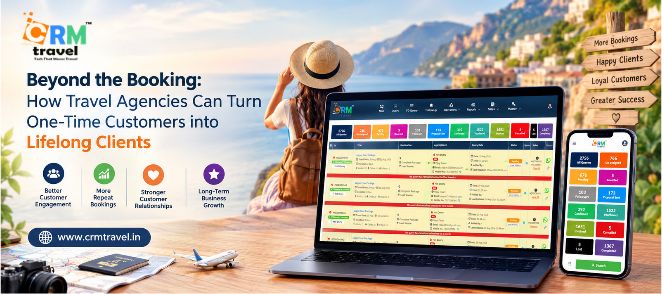
CRMtravel offers travel CRM capabilities for managing leads, follow-ups, quotations, bookings, customer interactions, and reporting. Agencies can explore how these workflows fit together to create a more organized customer journey.
Learn more about CRMtravel's travel CRM solutions.
9. Measure the Results of Your Retention Strategy
A retention strategy should be reviewed using actual business results rather than assumptions.
Start with a small set of meaningful measurements.
Repeat booking rate
This measures the proportion of customers who make another booking during a defined period.
A basic formula is:
Repeat booking rate = Customers with repeat bookings ÷ Total customers in the measured group × 100
Define the measurement period and customer group consistently before comparing results.
Time between bookings
Measure how long customers typically take to make another purchase. This can help your team understand when a future communication might be relevant.
Customer feedback trends
Track satisfaction, recurring complaints, service quality, and the issues that require repeated attention.
Follow-up completion rate
Measure how consistently your team completes planned customer follow-ups.
Revenue from returning customers
Calculate the revenue generated by returning customers during a specific period. If possible, review profitability as well, because revenue alone does not show the full business impact.
These metrics help agencies identify which activities are working and where improvements are needed.
Do not assume that every returning customer was caused by a particular campaign. Compare results carefully and consider factors such as seasonality, destination demand, pricing, and customer travel frequency.
10. How CRMtravel Can Support a More Organized Customer Journey
As a travel business grows, managing customer relationships manually becomes increasingly difficult.
A centralized platform can help bring sales activity and travel operations into a more consistent workflow.
CRMtravel provides travel-focused capabilities designed for travel agencies, tour operators, and destination management companies.
Relevant capabilities include:
◾Lead management: Organize incoming enquiries and customer records.
◾Follow-up management: Keep track of pending communication and sales activities.
◾Quotation and itinerary building: Prepare travel proposals in a more structured way.
◾Booking and operational management: Maintain visibility across relevant travel workflows.
◾Invoices and payment tracking: Organize financial activities associated with bookings.
◾Reporting: Review business activity and identify opportunities for improvement.
When these processes are connected, your team can spend less time searching for customer information and more time delivering useful service.
The goal is not to automate every conversation. It is to make sure your team has the information and reminders needed to communicate at the right time.
Explore CRMtravel's travel management platform to see whether its features align with your business requirements.
A Practical 30-Day Customer Retention Plan
Travel agencies do not need to overhaul every process at once. A focused 30-day plan can help establish a workable foundation.
Week 1: Organize customer records
Review existing records, remove unnecessary duplication, and standardize important fields such as travel preferences, booking history, and communication permissions.
Week 2: Establish a post-trip process
Create a thank-you message, feedback request, and process for recording customer concerns after a completed trip.
Week 3: Plan relevant communication
Develop a simple calendar for seasonal offers, upcoming travel periods, and appropriate follow-ups. Segment customers by their interests and requirements.
Week 4: Review performance
Check follow-up completion, customer responses, feedback trends, and any repeat enquiries or bookings. Identify what should be improved in the following month.
At the end of the month, your agency should have a clearer process for maintaining relationships with existing customers and identifying future opportunities.
The results will depend on customer demand, service quality, implementation, and how consistently the process is followed.
Conclusion
Sustainable travel business growth is not only about attracting more enquiries. It is also about making the most of the relationships your agency has already built.
Every completed trip provides an opportunity to learn more about a customer's preferences, improve your service, and prepare for future travel requirements.
By combining thoughtful post-trip communication, relevant recommendations, organized follow-ups, and consistent customer records, travel agencies can create a more connected customer experience.
As your business expands, travel CRM software can help turn these activities into repeatable workflows rather than leaving them to memory or manual tracking.
Ready to organize your travel business and strengthen customer relationships?
Discover how CRMtravel can help your team manage travel enquiries, follow-ups, quotations, bookings, and customer information through a connected travel management platform.
A better customer journey does not end at checkout. It creates a reason for travelers to return.