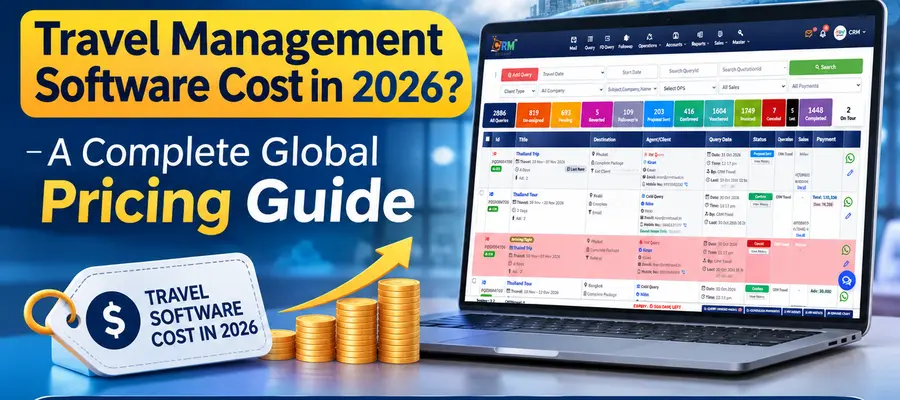
Quick Answer: What Does Travel Management Software Cost in 2026?
Travel management software in 2026 typically costs between US$300 and US$1,500 per month for small and mid-sized travel agencies, while enterprise deployments for large agencies, tour operator groups and corporate travel management companies (TMCs) can run from US$2,000 to well over US$10,000 per month, depending on users, modules, integrations and support.
A purpose-built travel CRM such as CRMtravel starts at ₹35,000 INR (roughly US$400, depending on the exchange rate). Higher tiers, namely the Advance Plan and Enterprise Plan, are priced according to team size, feature depth, customization, integrations and the compliance requirements of the country you operate in.
The short version: the sticker price is only part of the real cost. Implementation, data migration, training, payment gateway charges, local taxes and support all shape your total cost of ownership. This guide breaks every layer down so you can budget with confidence.
Table of Contents
1. What is travel management software?
2. Why the right travel CRM matters for agencies
3. Pricing models explained
4. Average cost by agency size
5. CRMtravel pricing: what to expect
6. Hidden costs most buyers miss
7. How country rules, taxes and terms affect pricing
8. Key features that justify the price
9. How to choose the best travel agency CRM software
10. Calculating ROI
11. Negotiation and buying tips
12. Final verdict
13. Frequently asked questions
What Is Travel Management Software?
Travel management software is a digital platform that helps travel agencies, tour operators, destination management companies (DMCs) and corporate travel teams manage the full journey of a customer: lead capture, itinerary building, quotation, booking, payment collection, supplier management, documentation, and post-trip follow-up.
The category is broad. When people search for travel software or the best travel software, they are usually looking at one of four product types:
• Travel CRM: manages leads, customers, sales pipelines, follow-ups and communication.
• Itinerary and quotation software: builds day-wise trip plans and priced proposals quickly.
• Booking and reservation engines: connect to flights, hotels, transfers and activities.
• Back-office and accounting tools: invoicing, supplier payables, commissions and reporting.
Modern platforms combine these into one system. That is why the most searched phrases today are CRM for travel agency and best travel agency CRM software: agencies want one workspace instead of five disconnected tools.
Why the Right Travel CRM Matters for Agencies
A general-purpose CRM tracks contacts and deals. A best travel CRM goes further because travel sales have unique problems:
• Enquiries arrive from many channels at once: WhatsApp, Instagram, website forms, email, phone and portals.
• Every trip is custom, so quotations change several times before confirmation.
• Customers compare multiple agencies and decide slowly, so follow-up timing decides who wins.
• Bookings involve many suppliers, currencies, deadlines and documents.
• Seasonality creates sudden spikes in workload.
Agencies that move from spreadsheets to a dedicated travel CRM commonly report faster response times, fewer lost leads and cleaner operations. The cost question is therefore really an investment question: what does it cost, and what does it return?
Travel Management Software Pricing Models Explained
Before comparing numbers, understand how vendors charge. Most use one or a blend of these models.
1. Per-User Subscription
You pay a fixed monthly or annual fee for each team member who logs in. This is the most common model for travel CRM tools. It is predictable and scales with headcount, but costs rise quickly for agencies with many sales agents or part-time staff.
2. Tiered Plans
Vendors bundle features into packages, typically Basic, Advance and Enterprise. Higher tiers unlock automation, advanced reporting, integrations, white-labeling and priority support. This is the model CRMtravel follows.
3. Per-Booking or Transaction-Based Fees
Some booking-focused platforms charge a small fee per reservation or a percentage of booking value. It suits low-volume agencies, but it becomes expensive when volume grows.
4. One-Time License
A lump-sum purchase for self-hosted software. It is now rare. Buyers still pay separately for hosting, maintenance, security updates and upgrades, which often makes it costlier over three to five years.
5. Custom or Quote-Based Pricing
Enterprise buyers with complex needs typically negotiate a custom contract that reflects users, integrations, data volume, service-level agreements and compliance obligations.
Average Travel Software Cost by Agency Size (2026 Estimates)
Prices vary by region and vendor, but the ranges below reflect what global buyers commonly encounter in 2026. Treat them as planning estimates, not guaranteed quotes.
| Agency type |
Typical team size |
Estimated monthly cost (USD) |
What you usually get |
| Freelance / home-based agent |
1 to 2 users |
$30 to $150 |
Basic lead tracking, templates, simple quotes |
| Small agency |
3 to 10 users |
$300 to $900 |
Travel CRM, itinerary builder, WhatsApp and email integration |
| Mid-sized agency / tour operator |
10 to 40 users |
$900 to $3,000 |
Automation, supplier management, accounting, analytics |
| Large agency / DMC / TMC |
40+ users |
$3,000 to $10,000+ |
Custom workflows, API integrations, white-label portals, dedicated support |
In Indian rupees, small and mid-sized agencies commonly budget from ₹35,000 upward, which is where CRMtravel's pricing begins.
CRMtravel Pricing: What to Expect
CRMtravel is built specifically as a CRM for travel agencies, so its pricing reflects a focused feature set rather than a generic business suite.
Starting Plan: From ₹35,000 INR
The entry plan starts at ₹35,000 INR. It is designed for growing agencies that want to replace spreadsheets and scattered chat threads with a structured sales and operations system. Typical value at this level includes lead management, pipeline tracking, customer records, itinerary and quotation tools, and follow-up reminders.
Advance Plan
The Advance Plan is priced above the starting tier and varies according to the number of users, automation needs, integrations and reporting depth. It suits agencies that have outgrown basic tools and want to automate repetitive work, such as follow-ups, document sharing and payment reminders.
Enterprise Plan
The Enterprise Plan is built for large agencies, multi-branch businesses and operators serving several markets. Pricing is tailored and depends on:
• Number of users and branches
• Custom workflows and role permissions
• API access and third-party integrations
• White-labeling and branded customer portals
• Data security, hosting and compliance requirements
• Onboarding, training and priority support level
Pricing Notes for Global Buyers
Plan pricing is quoted in Indian rupees, so the amount you pay in your own currency depends on the exchange rate at purchase. Local taxes such as GST in India, VAT in the European Union and United Kingdom, or sales tax in other jurisdictions may apply on top of the listed price, depending on your country and business registration. Always confirm the final invoice amount, billing cycle and applicable taxes with the vendor before signing.
Hidden Costs Most Buyers Miss
The subscription price is rarely the whole story. Budget for these items:
Implementation and Setup
Configuration of pipelines, user roles, templates, and branding can be included in higher plans or charged separately. Ask what is covered.
Data Migration
Moving customer records, past bookings and supplier data from spreadsheets or an old system takes time. Some vendors do it free, others charge per project.
Training and Onboarding
A tool is only valuable if your team uses it. Good vendors provide live onboarding, documentation and video training. Confirm whether these are included.
Integrations
Connecting WhatsApp Business API, payment gateways, accounting software, GDS or supplier APIs may carry extra fees. WhatsApp messaging in particular has its own per-conversation charges from the messaging provider.
Payment Gateway Fees
Collecting payments online usually costs between roughly 1.5% and 3.5% per transaction depending on country, card type and provider. This is separate from software cost.
Customization
Custom fields, reports or workflows beyond standard configuration may require development fees, especially at enterprise level.
Support Tiers
Standard support might be email only. Phone, dedicated account manager and 24/7 coverage are often premium options.
Renewal Increases
Some vendors discount the first year, then raise the price at renewal. Ask for renewal terms in writing.
Currency and Tax Effects
Fluctuating exchange rates and local taxes can change your effective cost by several percentage points over a year.
How Country Rules, Taxes and Terms Affect Software Pricing
Because travel businesses operate across borders, your legal location changes both price and obligations. Here is what to check in major markets.
India
Software subscriptions are generally subject to GST, currently 18% for most SaaS services. Registered businesses can often claim input tax credit. Indian agencies should also consider data handling under the Digital Personal Data Protection Act, 2023.
European Union and United Kingdom
VAT applies to digital services based on the customer's location and registration status. The GDPR and UK GDPR require lawful handling of traveler data, including passport details, so ask the vendor about data processing agreements, data residency and breach procedures.
United States
Sales tax on SaaS varies by state; some tax it and some do not. Agencies handling traveler information should review state privacy laws such as California's CCPA and CPRA, and many states also require seller-of-travel registration, which affects how you store and report transactions.
Middle East and Gulf Countries
VAT rules differ by country, for example the UAE and Saudi Arabia. Data localization expectations can apply in some sectors, so confirm hosting location.
Southeast Asia, Australia and Others
GST or VAT regimes and privacy laws such as Singapore's PDPA or Australia's Privacy Act affect contracts and data practices. Always match the vendor's terms to your local rules.
Contract Terms to Read Carefully
Regardless of country, review these clauses:
• Billing cycle and cancellation: monthly, quarterly or annual, and any notice period.
• Refund policy: conditions and timelines.
• Data ownership and export: can you take your data when you leave?
• Service-level agreement: uptime commitments and support response times.
• Security standards: encryption, access controls, backups.
• Price-change clause: how and when the vendor may raise fees.
These are general guidelines, not legal advice. For binding decisions, consult a qualified local advisor.
Key Features That Justify the Price
When comparing travel software, focus on features that directly affect revenue and efficiency.
Lead and Enquiry Management
Capture leads from websites, social media, WhatsApp, email and phone in one inbox. Automatic assignment to agents prevents leads from being ignored.
Sales Pipeline and Follow-Up Automation
Visual pipelines show where every enquiry stands. Automated reminders and messages protect conversion rates, since most travel sales are won through persistent follow-up.
Itinerary Builder and Quotations
Day-wise itineraries, pricing breakdowns and branded PDF or web proposals can cut quote preparation from hours to minutes.
Booking and Supplier Management
Track hotels, transport, guides and vendors, with payment deadlines and confirmations in one place.
Payments and Invoicing
Multi-currency invoices, payment links, partial payment schedules and automatic reminders reduce collection delays.
Customer Portal and Documents
Share tickets, vouchers and itineraries securely, which cuts repetitive customer questions.
Reporting and Analytics
Track conversion rate, revenue by destination, agent performance and lead source ROI so you can make decisions from data.
Integrations and APIs
Connections with accounting software, payment gateways, WhatsApp and supplier systems reduce manual data entry.
Security and Role-Based Access
Protect sensitive traveler data and control what each team member can see.
How to Choose the Best Travel Agency CRM Software
Use this seven-step framework when evaluating the best travel agency CRM software for your business.
Step 1: Define Your Needs
List your current pain points: lost leads, slow quotes, payment delays, poor reporting. Rank them by business impact.
Step 2: Set a Realistic Budget
Include subscription, setup, training, integrations and taxes. Plan for twelve months of total cost, not just the monthly fee.
Step 3: Shortlist Travel-Specific Vendors
A dedicated travel CRM understands itineraries, suppliers and seasonal workflows out of the box. A generic CRM may need costly customization.
Step 4: Run a Demo With Real Scenarios
Test your actual workflow: capture an enquiry, build a custom itinerary, send a quote, record a payment. Observe how many clicks each takes.
Step 5: Check Integrations
Confirm compatibility with the tools you already use, especially WhatsApp, payments and accounting.
Step 6: Verify Support and Security
Ask about response times, onboarding help, backups, encryption and data export.
Step 7: Start With a Pilot
Many vendors allow a trial or a short-term start. Test with a small team before rolling out company-wide.
Calculating the ROI of Travel Management Software
A simple way to evaluate cost is to estimate return.
ROI = (Annual gain from software − Annual cost) ÷ Annual cost × 100
Worked Example (Illustrative)
Suppose a small agency pays the equivalent of ₹35,000 per year-equivalent plan cost and handles 100 qualified enquiries a month. Before the CRM, it converts 10% of enquiries. After adopting structured follow-up, it improves conversion to 12%.
• Additional bookings per month: 2
• Average margin per booking: ₹15,000
• Additional monthly margin: ₹30,000
• Additional annual margin: ₹3,60,000
Even after adding setup and training, the return is a multiple of the investment. These numbers are an example only; your results depend on your market, team and execution.
Other Savings
• Hours saved on manual quote creation
• Fewer booking errors and missed deadlines
• Faster payment collection
• Reduced reliance on spreadsheets
• Lower staff onboarding time
Negotiation and Buying Tips
• Ask for annual billing discounts. Many vendors offer savings for yearly commitments.
• Bundle onboarding and training into the contract.
• Negotiate user count flexibility, so you can add seats without penalty.
• Lock renewal pricing for at least two years if possible.
• Buy off-season, when vendors may be more flexible and your team has time to learn the tool.
• Request a written scope for every Advance or Enterprise customization.
• Clarify data export rights before you sign.
Common Mistakes When Buying Travel Software
1. Choosing the cheapest tool and paying later in workarounds.
2. Buying features you will never use.
3. Ignoring local tax and data rules.
4. Skipping team training.
5. Failing to migrate data cleanly.
6. Not checking how the vendor handles support after the sale.
Travel Software Trends to Watch in 2026
• AI-assisted itineraries and replies: drafting trip plans and customer responses faster.
• WhatsApp-first selling: conversational commerce is now the main channel in many markets.
• Automation of follow-ups: timed reminders based on lead behavior.
• Multi-currency and multi-language support: essential for global agencies.
• Stronger privacy controls: travelers expect secure handling of passports and payments.
• Deeper analytics: better attribution from lead source to final booking.
These trends push expectations upward, so a modern travel CRM is becoming a baseline requirement rather than a luxury.
Final Verdict: Is Travel Management Software Worth the Cost?
For most travel businesses in 2026, yes. The question is not whether to invest, but which tool fits your size, markets and growth plans. A dedicated travel CRM reduces lost leads, speeds up quoting, tightens operations and gives you the data to grow.
If you are comparing the best travel software options, look beyond the headline price. Evaluate total cost of ownership, local taxes and compliance, support quality and how well the platform handles your real daily workflow.
CRMtravel offers a travel-focused starting point from ₹35,000 INR, with Advance and Enterprise plans that scale as your agency grows across markets.
Ready to see it in action? Book a demo with CRMtravel, bring your real workflow, and request a written quote that includes taxes, onboarding and support so you know your exact cost before you commit.
Disclaimer: Pricing ranges in this article are general market estimates for planning purposes and are not binding quotes. Taxes, exchange rates and terms vary by country and may change. This content is informational and does not constitute legal, tax or financial advice.
Frequently Questions
Everything you need to know — answered clearly
How much does travel management software cost in 2026?
+
Small agencies typically pay US$300 to US$900 per month, mid-sized businesses US$900 to US$3,000, and large enterprises US$3,000 or more. A dedicated travel CRM like CRMtravel starts at ₹35,000 INR, with Advance and Enterprise plans priced by features, users and requirements.
What is the best travel CRM for a small agency?
+
The best travel CRM for a small agency is one that is travel-specific, easy to learn and affordable, with lead management, itinerary and quote tools, WhatsApp integration and follow-up automation. Run a demo using your real workflow before deciding.
Why choose a CRM for a travel agency instead of a generic CRM?
+
Generic CRMs are built for standard sales. A travel CRM handles itineraries, suppliers, multi-step quotations, trip documents and seasonal demand without heavy customization.
What does CRMtravel cost?
+
CRMtravel pricing starts from ₹35,000 INR. The Advance Plan and Enterprise Plan vary based on user count, features, integrations, customization and compliance needs. Local taxes and exchange rates may apply depending on your country.
Are there hidden costs in travel software?
+
Possible additional costs include implementation, data migration, training, integrations, payment gateway fees, customization, premium support and renewal increases. Always request a full written quote.
Does travel software pricing differ by country?
+
The base price may be the same, but taxes such as GST and VAT, currency conversion, data protection obligations and local registration rules can change the final amount and contract terms.
Can travel software pay for itself?
+
Yes, when it improves lead conversion, speeds up quotes and reduces errors. Even a small improvement in conversion rate can outweigh the subscription cost for many agencies.
Is cloud-based travel software safe?
+
Reputable cloud platforms use encryption, access controls and regular backups. Ask your vendor about security certifications, data residency and breach procedures.
How long does it take to implement a travel CRM?
+
Small teams can often start within days to a few weeks. Enterprise rollouts with custom workflows and integrations may take one to three months.
Can I switch travel software later?
+
Yes, provided your contract allows data export. Check this before signing to avoid vendor lock-in.